
Organizational AI maturity model

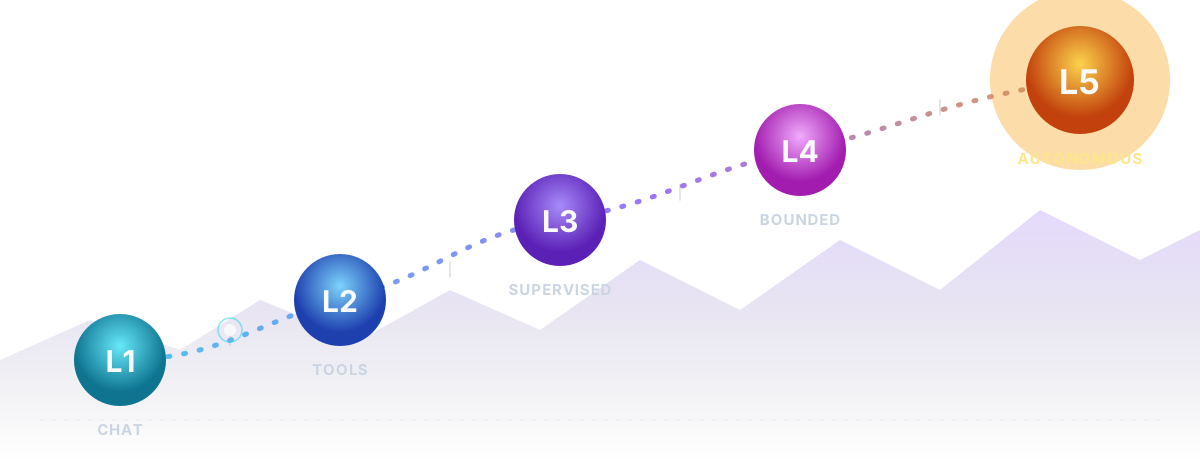
Five levels of AI usage in modern organizations

A practical map for understanding how companies move from basic AI conversations to autonomous operators with governance, examples, and guardrails.

Discover your AI maturity score Answer a few strategic questions and see where your organization stands.

Higher levels increase capability, integration, and accountability requirements.

Each level builds on the previous one. Successful adoption depends on clear data access, workflow design, security controls, evaluation, monitoring, and human ownership.

How mature is your organization’s AI usage?

Find out whether your teams are experimenting, operationalizing, scaling, or ready for autonomous AI capabilities. Your personalized score maps directly to the five AI levels below.

Start the AI Maturity Evaluation
Illustration for Conversational Assistant Level 1

Level 1

Conversational Assistant

People ask, AI answers.

Employees use chat-based AI to draft, summarize, brainstorm, translate, and explain information. Humans remain fully responsible for taking action.

Examples
  • Drafting customer emails and internal announcements
  • Summarizing meeting notes, PDFs, and research
  • Brainstorming campaign ideas or policy language

Illustration for Conversational Assistant with Tools Integration Level 2

Level 2

Conversational Assistant with Tools Integration

AI can look things up and prepare work.

The assistant connects to approved tools, files, databases, or APIs. It can retrieve current information and prepare structured outputs while a person reviews and executes.

Examples
  • Searching knowledge bases and CRM records
  • Producing spreadsheets, tickets, or draft reports
  • Checking calendars, inventory, or analytics dashboards
Illustration for Supervised Task Agent Level 3

Level 3

Supervised Task Agent

AI completes steps under human approval.

The AI follows a defined workflow, performs multi-step tasks, and pauses for confirmation at important checkpoints. Humans supervise quality, risk, and final decisions.

Examples
  • Preparing procurement comparisons for manager approval
  • Creating support ticket responses and suggested actions
  • Running compliance checks with exception review
Illustration for Bounded Autonomous Agent Level 4

Level 4

Bounded Autonomous Agent

AI operates independently inside guardrails.

Agents act without step-by-step supervision within clearly bounded policies, budgets, permissions, and monitoring. Humans manage objectives and handle escalations.

Examples
  • Autonomously triaging routine support requests
  • Rebalancing ad spend within approved thresholds
  • Monitoring systems and remediating known incidents
Illustration for Autonomous Operator Level 5

Level 5

Autonomous Operator

AI owns outcomes across systems.

AI operators plan, execute, monitor, and improve cross-functional processes. Governance focuses on strategic goals, auditability, safety, and exception handling.

Examples
  • Managing an end-to-end back-office process
  • Operating a digital sales development function
  • Continuously optimizing supply chain actions

Build trust as autonomy increases.

Policy

Define what AI may access, decide, and execute.

Evaluation

Measure quality, risk, bias, latency, and business impact.

Observability

Log actions, approvals, exceptions, and outcomes.

Escalation

Keep humans in control of ambiguous or high-risk cases.